What Is a Tax Accountant? Key Roles, Differences from a CPA, and Why It Matters for Arizona Businesses
In Arizona’s dynamic business environment, especially the booming startup scene in Phoenix, having the right financial professional can make or break your venture. A tax accountant plays a crucial role in helping individuals and businesses stay compliant with tax laws while minimizing liabilities. Yet many founders wonder, Is a tax accountant enough, or do I need a full CPA?
What exactly is a tax accountant?
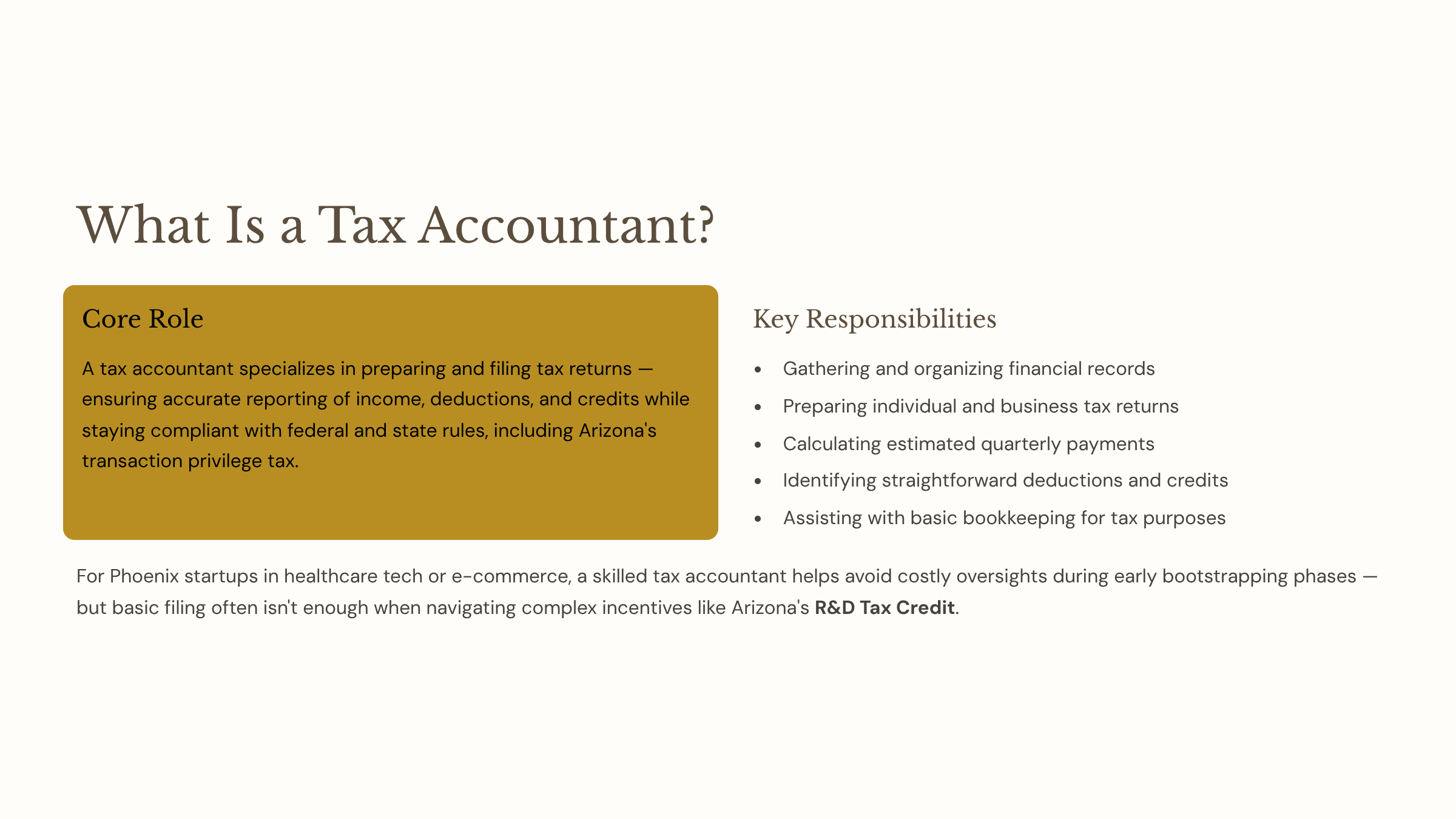
A tax accountant is a professional who specializes in preparing, filing, and managing tax-related matters. Their primary focus is ensuring accurate reporting of income, expenses, deductions, and credits to federal and state authorities. In everyday terms, they handle the “compliance” side of taxes—making sure your returns are filed correctly and on time.
Core responsibilities of a tax accountant typically include:
- Collecting and organizing financial documents such as receipts, invoices, and bank statements.
- Preparing and filing individual, business, and payroll tax returns.
- Calculating estimated quarterly tax payments to avoid underpayment penalties.
- Identifying basic deductions and straightforward tax credits.
- Assisting with bookkeeping tasks specifically tailored for tax purposes.
- Advising on routine tax planning strategies to reduce current-year tax burdens legally.
For small businesses and early-stage startups in Phoenix and Scottsdale, a skilled tax accountant can prevent simple mistakes such as misclassifying expenses or overlooking standard deductions. However, as ventures grow — particularly those involved in innovation, R&D, or raising capital — the limitations of basic tax accounting often become clear.
Tax Accountant vs CPA: Understanding the Critical Differences
While the terms are sometimes used interchangeably, there are important distinctions between a tax accountant and a Certified Public Accountant (CPA).
A tax accountant may hold certifications like an Enrolled Agent (EA) or simply have strong experience in tax preparation. They excel at day-to-day compliance and filing, but generally lack the broad authority and advanced training of a CPA.
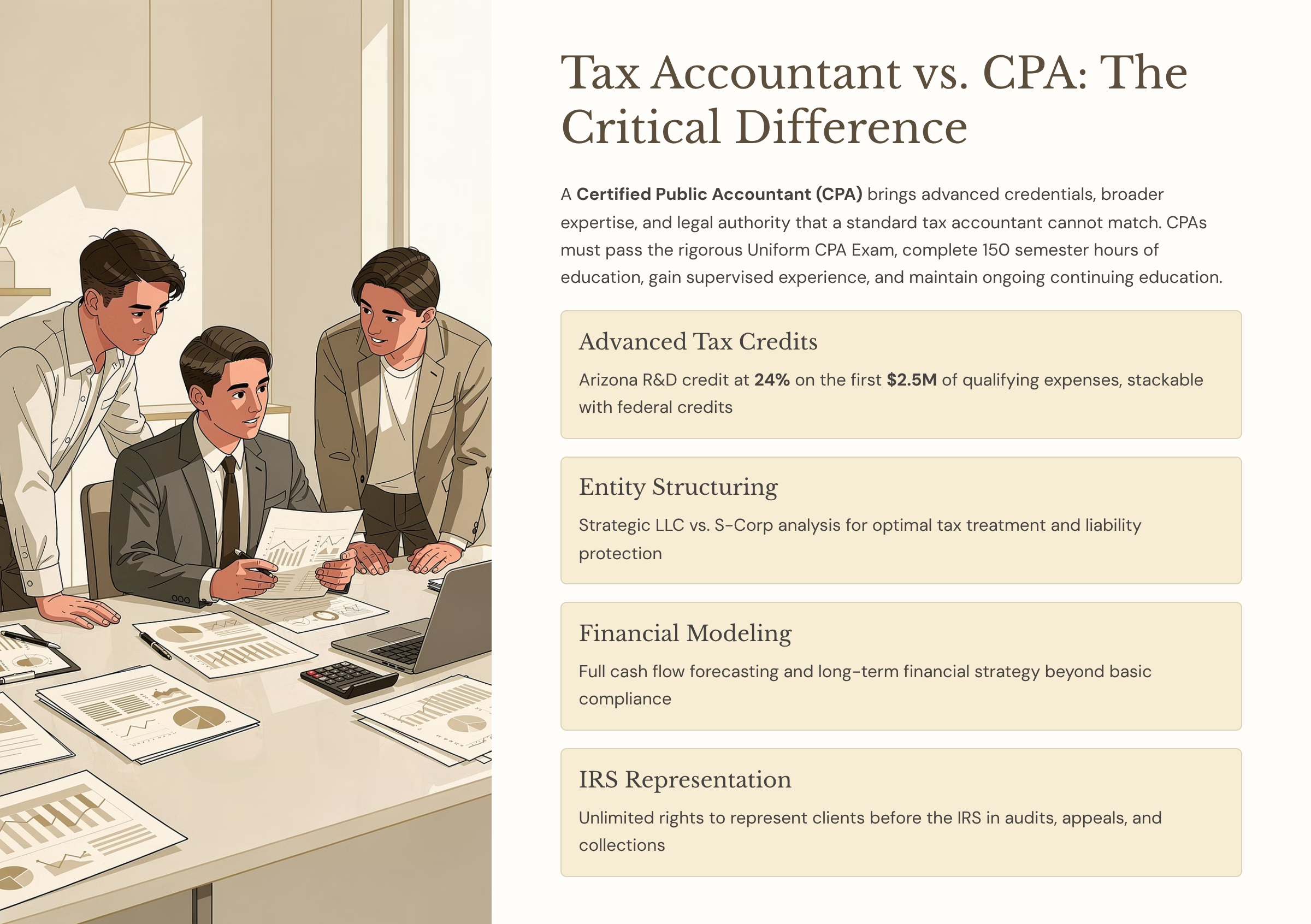
A CPA, such as Jim Chaston at Chaston Liberty, must meet rigorous requirements set by the Arizona State Board of Accountancy. This includes completing 150 semester hours of education (a bachelor’s degree plus additional credits), passing the Uniform CPA Exam (four sections covering auditing, business concepts, financial reporting, and regulation), gaining 2,000 hours of supervised experience, and passing an Arizona-specific ethics exam. CPAs must also complete 80 hours of continuing professional education every two years to maintain their license.
The greatest practical difference? Representation rights. Only CPAs (and EAs in limited tax matters) have unlimited rights to represent clients before the IRS and Arizona Department of Revenue in audits, appeals, and collections. A general tax accountant typically cannot provide this level of advocacy.
For Arizona startups, this distinction is especially meaningful. A CPA can:
- Strategically structure your business entity (LLC, S-Corp, or C-Corp) to optimize taxes and liability protection.
- Help claim advanced incentives like Arizona’s R&D Tax Credit — 24% on the first $2.5 million in qualifying research expenses, plus 15% on amounts above that through 2030. This credit is stackable with federal incentives and can even offset payroll taxes for pre-revenue companies.
- Provide comprehensive financial modeling, cash flow forecasting, and audit-ready documentation.
- Guide you through complex issues like transaction privilege tax (TPT) compliance, which applies to most business activities in Arizona and is often misunderstood by new founders.
Why Arizona Businesses and Startups Need Expert Tax Guidance
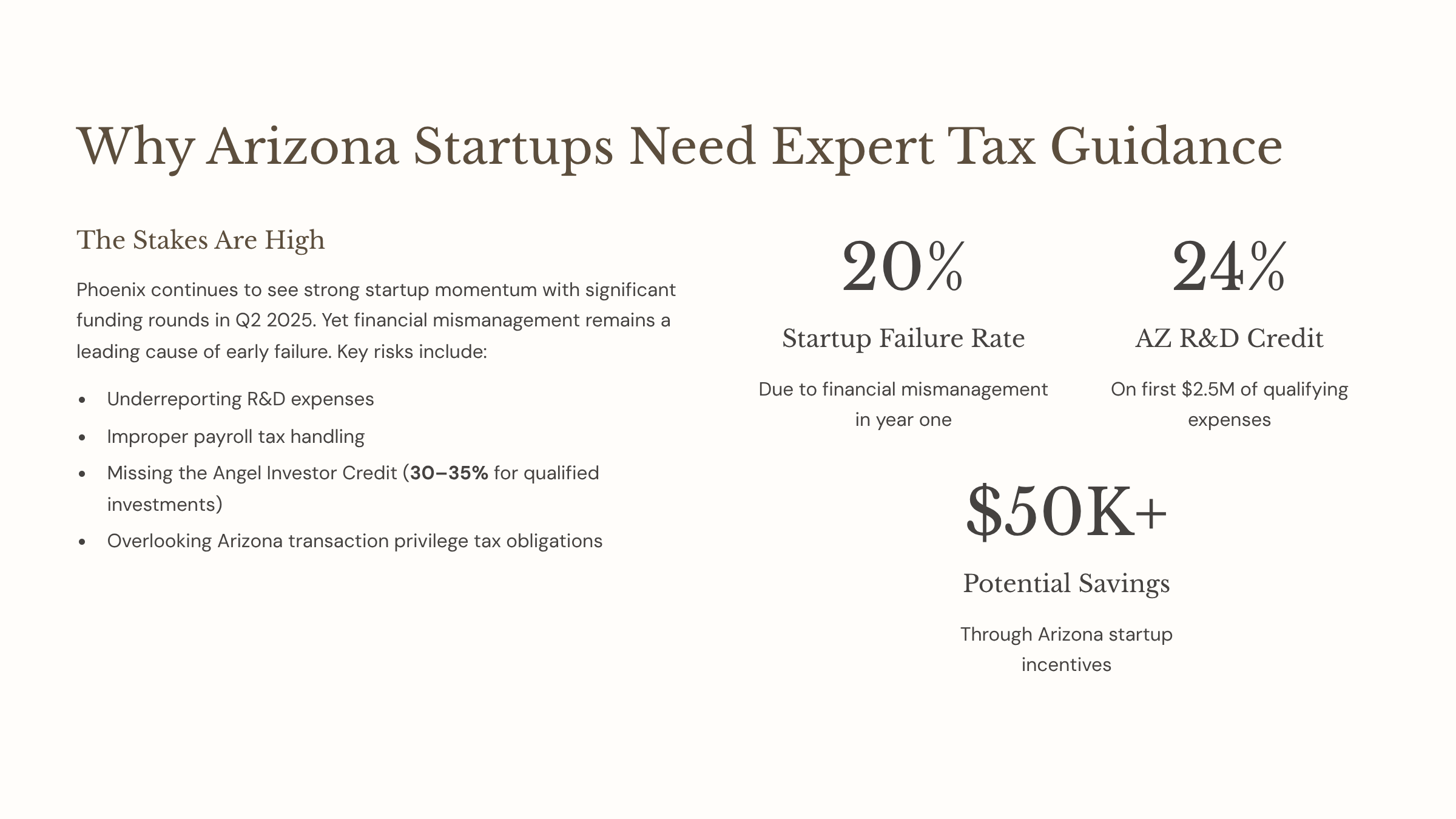
Phoenix has seen impressive startup activity, with hundreds of new ventures launching annually and significant funding raised across sectors such as healthcare tech. Yet the reality remains challenging: approximately 20% of new businesses fail in their first year, with financial mismanagement and tax oversights among the leading causes. Cash flow problems and poor tax planning contribute heavily to these failures.
Many early-stage founders initially rely on a basic tax accountant for simple filings. This works for straightforward situations but leaves money on the table for Arizona-specific opportunities. For example:
- Underreporting qualifying R&D activities (wages, supplies, and contract research) can mean missing out on tens or even hundreds of thousands in credits.
- Failing to properly handle Arizona’s transaction privilege tax (a vendor tax on the privilege of doing business, with a statewide base rate of 5.6% plus local add-ons) can trigger penalties during audits.
- Choosing the wrong entity structure early on can lead to higher taxes or limited access to grants and investor capital later.
Chaston Liberty’s Approach: Bridging Basic Compliance and Strategic Growth

At Chaston Liberty, James A Chaston CPA, and the team specialize in serving Arizona startups and small businesses. They combine precise tax accounting services with full CPA expertise to help founders claim maximum credits, structure finances efficiently, and avoid common pitfalls that derail many new ventures.
Real-world impact includes guiding Phoenix tech startups to secure over $100K in R&D credits and helping Scottsdale e-commerce businesses save $40K+ through smart entity optimization — all while maintaining full compliance.
Common Pitfalls Arizona Founders Face (and How to Avoid Them)
- Treating all expenses the same — without proper categorization for R&D credits.
- Ignoring state-specific rules like TPT on retail, contracting, or services.
- Waiting until tax season to organize records instead of maintaining year-round systems.
- Using out-of-state or generic online tax services that miss local incentives and nuances.
- Underestimating the value of proactive planning versus reactive filing.
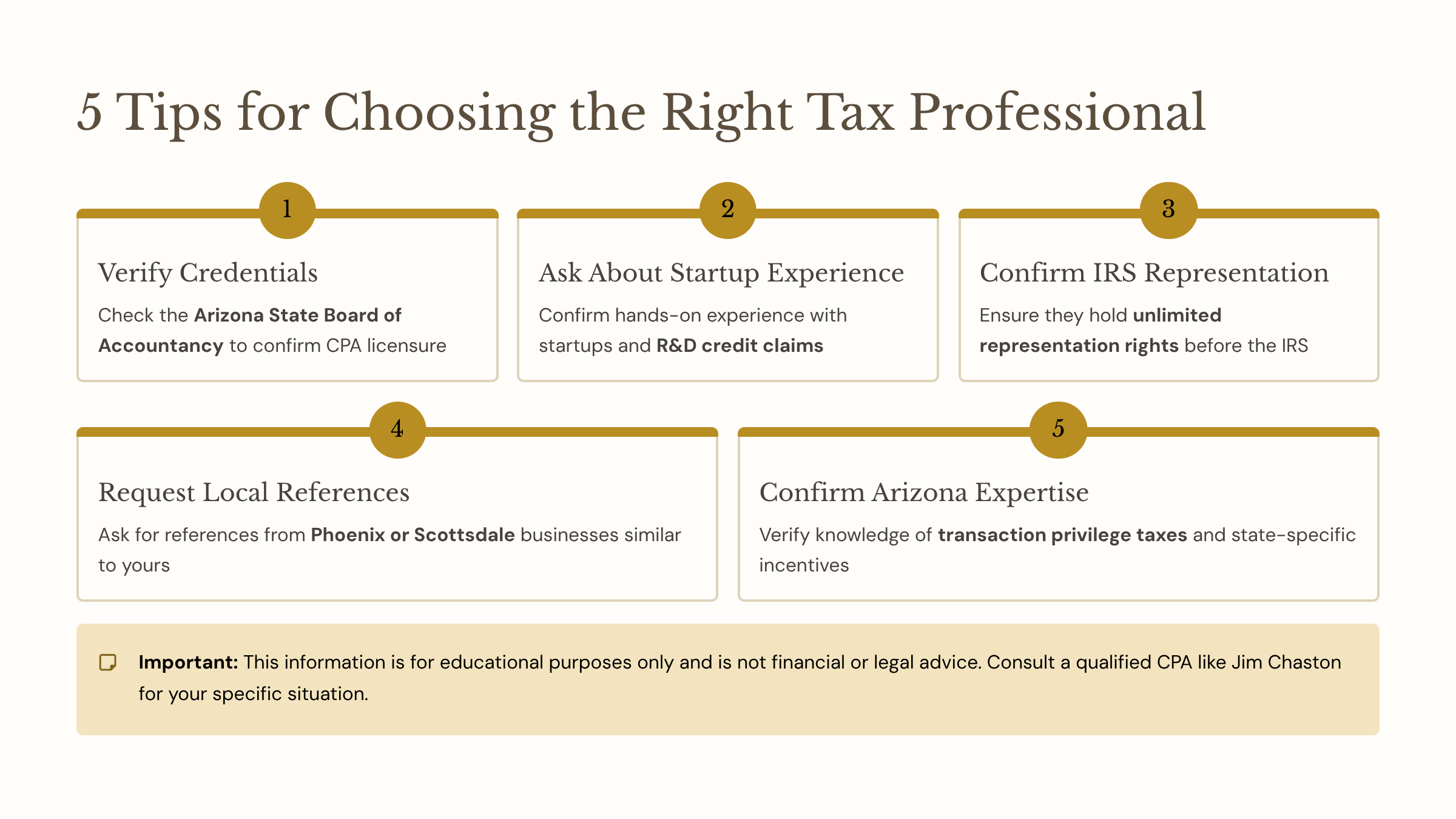
Actionable Tips for Choosing the Right Tax Professional in Arizona
- Verify credentials directly with the Arizona State Board of Accountancy.
- Ask specifically about experience with startups, R&D credit claims, and Arizona TPT compliance.
- Inquire whether the professional can represent you in IRS or state audits.
- Request case examples or references from similar Phoenix-area businesses.
- Ensure they offer both compliance services and forward-looking strategic advice.
Internal Links for Further Reading on Chaston Liberty CPA:
- CPA for Early-Stage Startups: Tax Credits and More
- Unlock $50K+ in Tax Savings: Arizona’s Startup Incentives
- Business Startup Consultant in Arizona: Services and Tips
- The Unique Risks and Arizona’s Tax Credit Solutions
- Online CPA for Arizona Startups: Worth the Risk?
- Contact Us for Personalized Startup Guidance
External Resources:
- Arizona Department of Revenue – Research & Development Tax Credit Forms
- Arizona Commerce Authority – R&D Tax Credit Program Details
- Arizona Department of Revenue – Transaction Privilege Tax Overview
- Arizona State Board of Accountancy – Official CPA Licensing Information
- Greater Phoenix Economic Council – Startup Ecosystem Resources
- Arizona Small Business Development Center – Free Business Support
Important Note: This information is provided for educational purposes only and does not constitute financial, tax, or legal advice. Every business situation is unique. Please consult a qualified CPA for advice tailored to your specific circumstances.
Ready to go beyond basic tax filing? Schedule a free consultation with James A Chaston CPA at Chaston Liberty today. Whether you need reliable tax accounting services or comprehensive CPA guidance for your Arizona startup, our team is here to help you claim every available credit, reduce risks, and build a financially strong foundation for long-term success. Don’t become part of the 20% that fail due to financial oversights — partner with a trusted local Phoenix expert who understands Arizona’s unique incentives and challenges.